
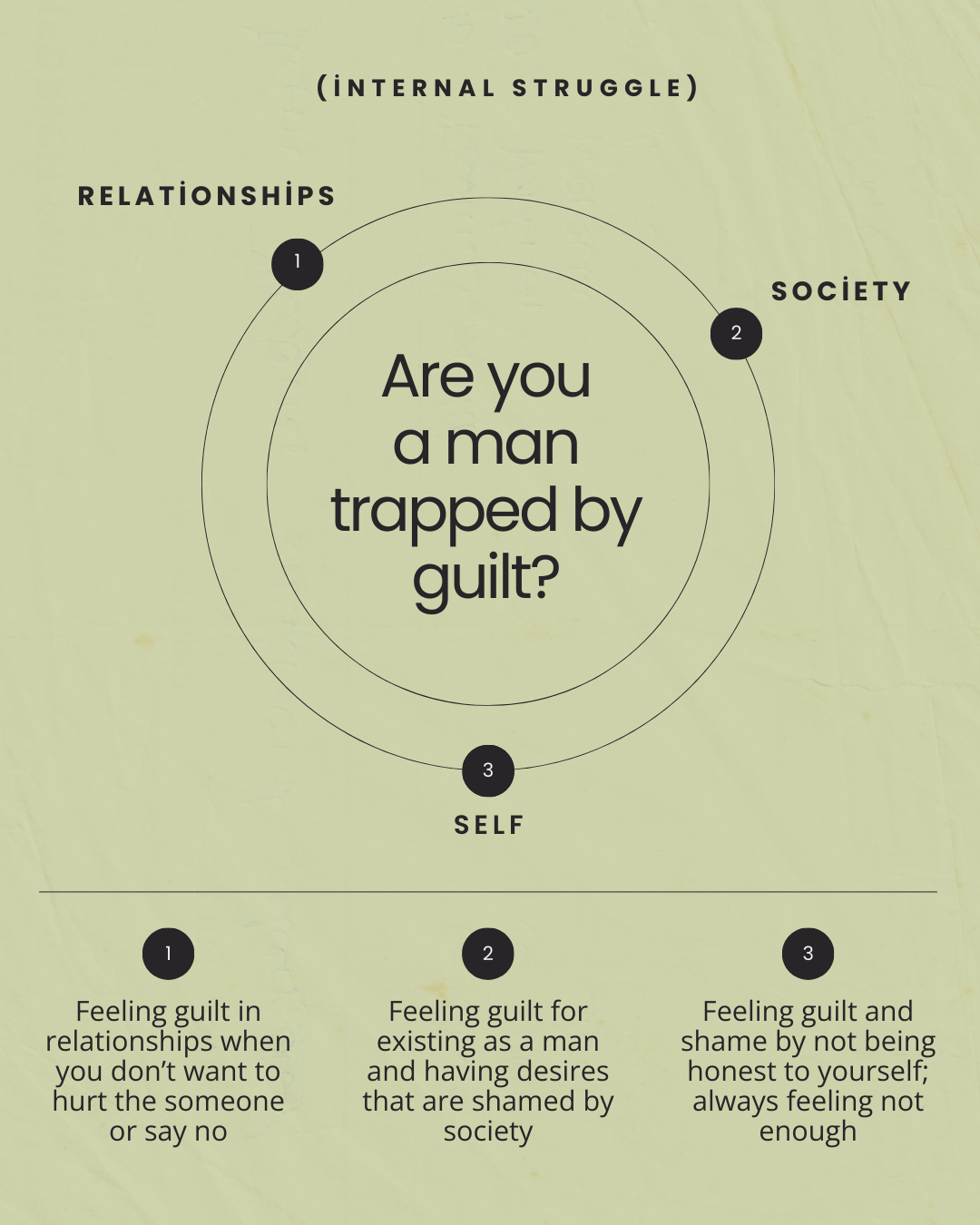
For men, sometimes it’s safer to feel guilt than it is to be angry.
Often, men are told to be strong, assertive, decisive… and to not hurt anyone, not be “too much,” not take up too much space. Internally, it can feel like a double bind.
Guilt isn’t a “male trait” or unique to men. But in my practice it's the most common theme amongst all male clients.
Healthy Guilt vs Chronic Guilt
Healthy guilt
Can signal that we crossed a personal or shared value; maybe we hurt someone we care about or our actions were misaligned with integrity. This kind of guilt is usually specific (related to an action) and it can lead to repair through empathy and changing behaviours.
Chronic guilt
Is vague and/or constant; showing up whenever you rest, set boundaries, or choose yourself. This guilt is no longer guiding you toward honesty; it’s pulling you away from your own voice and agency (ie. your ability to act and choose).
Chronic guilt is a body and nervous system regulation coping strategy to avoid pain and discomfort.
For men, feeling guilt is safe way to stay in connection and to avoid conflict. Even though it’s not actually safer in the long run but it often feels safer to the nervous system in the moment.
In a Grinberg session, we explore whether the guilt you are feeling reflects a real need for repair or whether it is a habitual bodily response to the discomfort of choice, conflict, or self-assertion. This page is dedicated to men, because society’s conflicting expectations often lead to chronic guilt.
Chronic guilt feels safer because it reduces external conflict, preserves connection, avoids vulnerable emotions, keeps identity intact …but it does so by collapsing the body, suppressing needs and limits choice.
So it’s short-term safety at the cost of long-term vitality and agency.
Contradicting expectations placed on men and how they lead to guilt
Society has so many contradicting expectations put men in a double bind. When no option feels safe, the nervous system looks for the least threatening exit… and guilt becomes that exit. How many of these can you relate to?

Double binds are just one example of how and why men experience guilt.
Depending on your history and coping style, the way you hold automatic guilt is individual.
Chronic guilt does not always appear as sadness or remorse. For many men, it becomes a way the body learns to manage pressure, expectations, conflict, and connection. Over time, these coping patterns can become automatic responses to stress and discomfort.
Examples of how men cope with guilt
-
Overworking and constant productivity
Some men cope with guilt by staying constantly busy. Work, achievement, or productivity become ways to avoid feelings of inadequacy, disappointment, or self-judgment. Rest can feel uncomfortable or undeserved, leading to chronic tension, exhaustion, and difficulty slowing down.
-
Emotional shutdown and disconnection
When guilt becomes overwhelming, some men disconnect from their emotions altogether. They may struggle to express vulnerability, avoid difficult conversations, or feel emotionally distant in relationships. In the body, this can appear as shallow breathing, tightness in the chest, or a general sense of numbness.
-
Numbing through distraction or compulsive habits
Some men cope with chronic guilt by keeping their attention constantly occupied through screens, food, alcohol, exercise, pornography, gaming, or other compulsive behaviours. These habits are often attempts to reduce inner tension and avoid difficult emotional states rather than signs of weakness or lack of discipline.
-
People pleasing and over-responsibility
Many men learn to cope with guilt by prioritising everyone else’s needs before their own. They may struggle to say no, carry responsibility for other people’s emotions, or feel guilty when setting boundaries. Over time, this can lead to resentment, fatigue, and a loss of connection to their own needs.
-
Anger, irritability, or frustration
For some men, guilt does not look soft or self-critical. It can appear as frustration, impatience, defensiveness, or emotional reactivity. Underneath the anger is often a nervous system carrying pressure, shame, or the fear of failing others.
-
Withdrawal and isolation
When guilt becomes chronic, some men pull away from relationships, intimacy, or support. Isolation can feel safer than the risk of disappointing others or feeling exposed. While this may reduce discomfort temporarily, it often increases loneliness and emotional disconnection over time.
What happens in the long term if men do not address chronic guilt?
When chronic guilt goes unaddressed, it can slowly shape the way a person relates to themselves, their body, their relationships, and the world around them. What may begin as a coping strategy can eventually become a deeply ingrained pattern of tension, self-criticism, and emotional disconnection.
Many men begin to lose touch with their own needs, desires, and boundaries. They may become highly responsible for others while quietly neglecting themselves. Over time, this can contribute to burnout, resentment, emotional numbness, and a persistent sense of pressure or inadequacy.
In relationships, chronic guilt can make it difficult to communicate honestly, set healthy boundaries, or tolerate conflict without collapsing into self-blame. Some men become emotionally withdrawn, while others become overly accommodating in order to maintain connection and avoid disappointing others.
The body is often deeply affected as well. Chronic guilt can contribute to ongoing nervous system activation, shallow breathing, muscular tension, fatigue, digestive issues, sleep problems, and difficulty relaxing. Many men live in a near-constant state of internal pressure without realising how much effort their body is using simply to hold everything together.
Over time, guilt can stop functioning as a healthy emotional signal and instead become a habitual way of relating to life. Rather than helping a person act with integrity, it begins to limit spontaneity, confidence, vitality, and the ability to make clear choices.
The good news is that these patterns are not fixed. With the right support, it is possible to build greater awareness, reconnect with the body, and learn new ways of responding to discomfort, responsibility, and emotional pressure without carrying chronic guilt as a constant burden.
How the Grinberg Method can help
-
Distinguish which types of guilt you are experiencing
It’s important to determine if what type of guilt is playing out:
• Discern which guilt is ethical information and
• Which guilt is a conditioned response to discomfort
When guilt appears, we explore whether it reflects a real need for repair or whether it is a habitual bodily response to the discomfort of choice, conflict, or self-assertion.
The type of guilt determines the approach.
-
Understand your chronic guilt patterns
Depending on your history and coping style, the way you hold automatic guilt is individual. Together we will unravel:
• How you hold guilt on different levels
• What triggers automatic guilt in you
• How to stop automatic guilt
• Your history around guilt
• What you actually want
-
Train the body to hold discomfort & conflict
We are not trying to eliminate guilt but instead:
• Recognise guilt can be a a signal that an old habit is being challenged
• Learn to stay present with the discomfort underneath guilt
• Learn to build bodily capacity to hold conflict, boundaries, and self-choice
• You are teaching your system to say: “I can stay connected and choose myself without collapsing into guilt.
WHAT NEXT?
Try it out:
Book an intake Session
Please call me on +49 16093174337 if you can’t find a suitable time.
-
Intake Sessions: 90 mins
In the first session, we will get to know each other. The first session also includes an initial diagnosis and a standard treatment, just like any regular session.
Goal: In the first session, you can find out, without obligation, whether the Grinberg Method is right for you.
Follow up sessions: 60 mins
We will begin by discussing any special circumstances and changes since the last session. This will be followed by the regular body-oriented psychotherapy portion. At the end, you will have a few minutes alone to rest.
-
Ostenstraße 11, 85072 Eichstätt, Germany (1 hour from Munich)
Google Maps: htps://maps.app.goo.gl/6X6hgUYJXNzLv6wQ7
-
Sessions are usually conducted with partial clothing / underwear. If you prefer to wear clothes, that’s also ok.
-
In-take Sessions €135 (90 mins)
Follow Up Sessions €110 (60 mins)
-
This totally depends on your insurance. Some private insurances cover all or only part of the treatment while the German public health insurance does not cover any costs
-
Yes.
-
You can reschedule or cancel your appointment free of charge 48 hours prior.
Changes last minute incur 85% no shows incur the full 100% fee.
If you are sick, there is no charge, just send a medical certificate / report via email.