
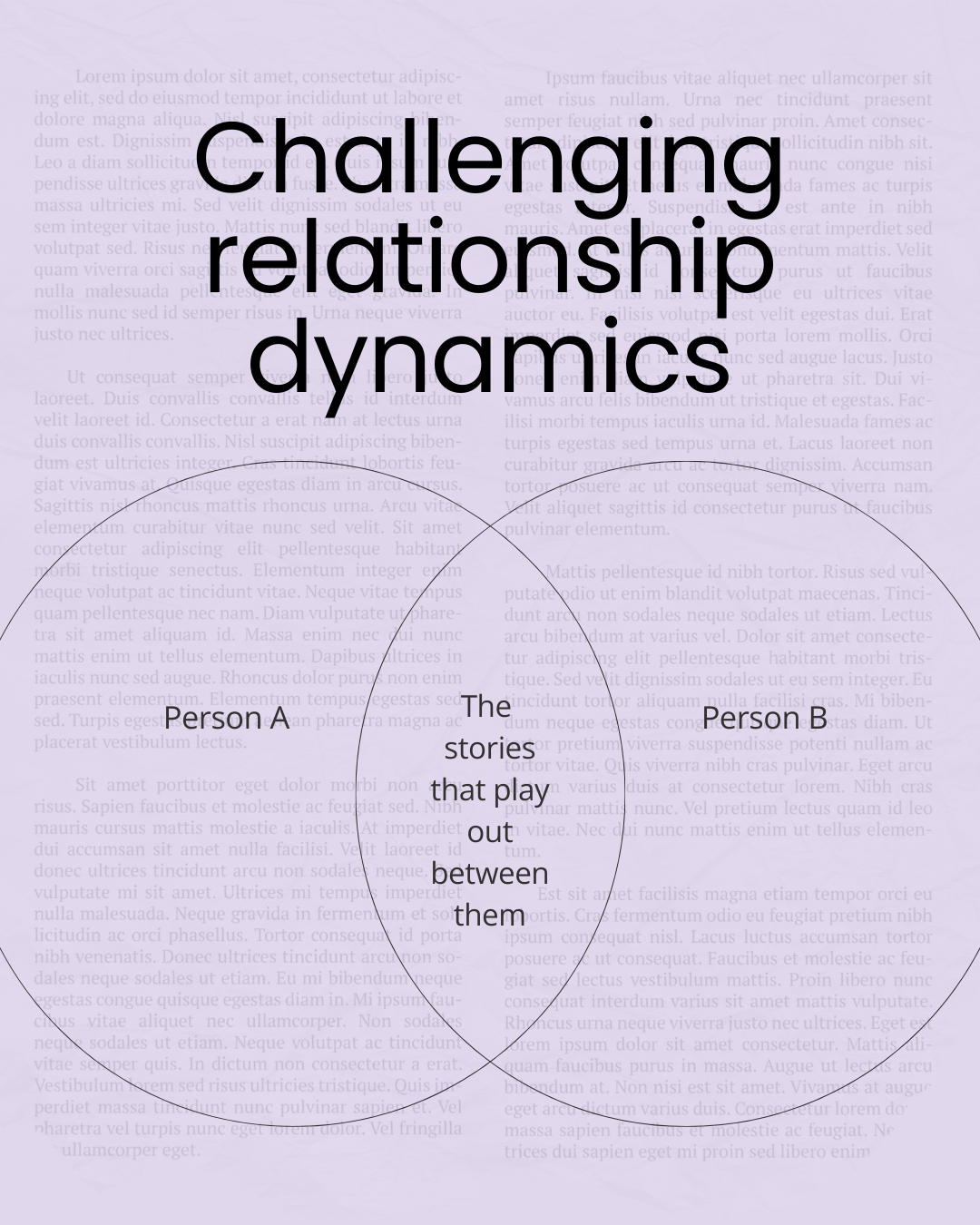
Your relationship patterns will follow you everywhere
That’s the good news and the bad news. If you work on your relationship patterns, it’s likely you will experiences changes in all areas of life. If you don’t, the patterns will continue to play out in all areas of life.
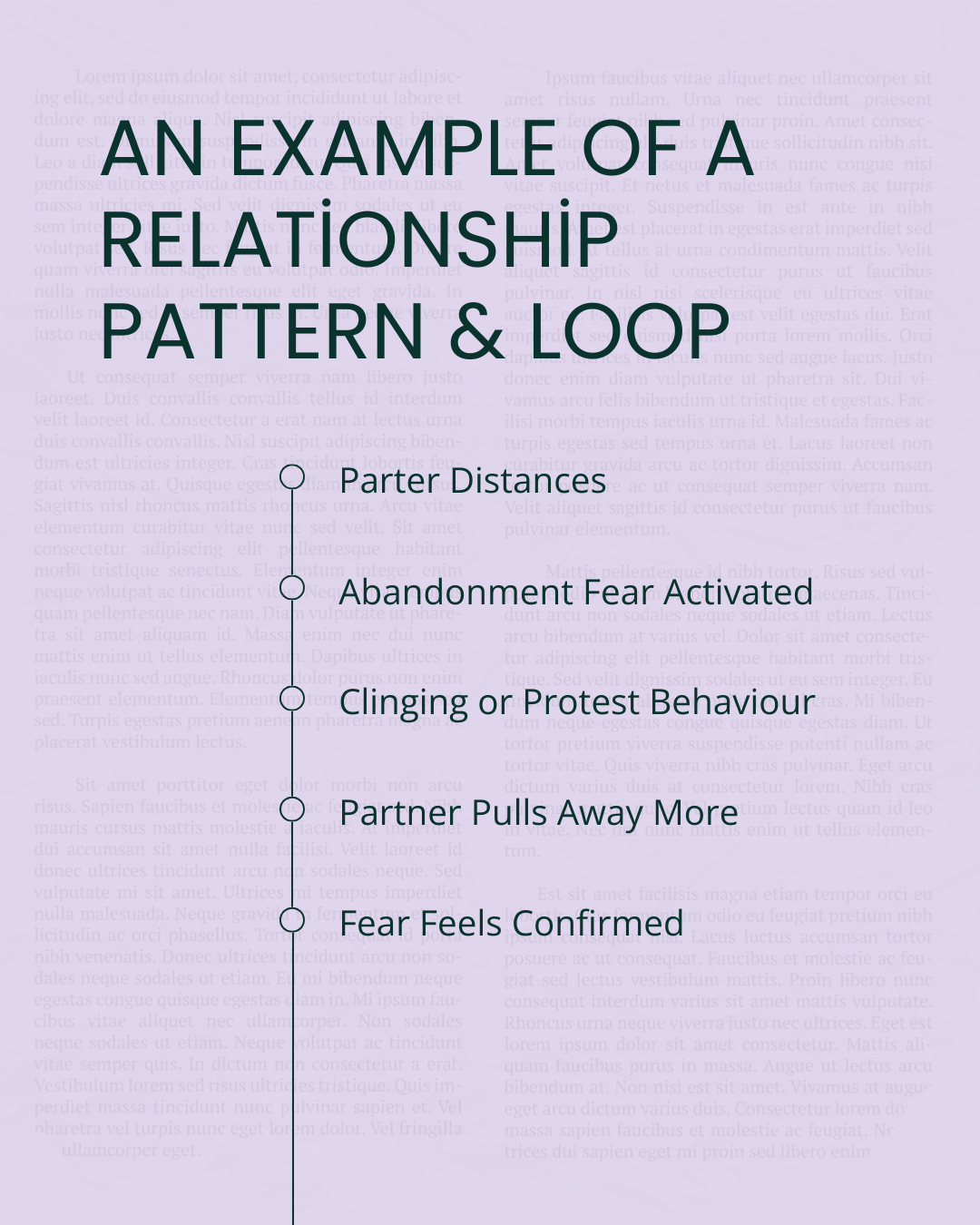
Are your relationship patterns driven by fear?
Relationships usually start off exciting, fun and erotically charged. We are curious and interested in discovering all there is to know about the other person. Everything feels new and we invest time, energy and resources in cultivating and deepening this new relationship. During this “honeymoon” phase, the people we are dating get to see the “best sides” of us.
Over time, as we get settled and things become familiar, and the honeymoon phase fades and our core relationship fears start to emerge and we start to behave in ways that show our wounds.
Even if you aren’t aware of your fears or even if you try to hide them, your partner feels the disconnect.
They experiences your behaviour when you’re triggered by fear… which then triggers their fears and behaviour patterns.
Relationship fears and patterns start in our childhood
Even if you grew up in a healthy family environment, you’ll naturally still have fears when it comes to relationships. Everyone experiences hurt and pain and most of us want to avoid it.
Here are some classic textbook examples:
You are a girl up who grew up with an absent father and now as an adult you fear abandonment and rejection.
You are a boy who grew up with a needy mother and now you fear being responsible for someone else’s feelings.
You grew up in a household with a lot of conflict and now you avoid it all costs. OR…
You grew up in a household with zero conflict and now avoid it all costs.
Why are relationship patterns so hard to break?
When our relationship fears are triggered, we don’t consciously choose our reactions.
Instead, the nervous system goes into automatic survival patterns: withdrawing, controlling, pleasing, shutting down, attacking, or clinging.
You might be surprised to know, research in psychology, attachment theory, and neuroscience shows that we are often unconsciously drawn to partners who activate familiar emotional patterns from childhood, even when those patterns are painful.
Our brains are wired to prefer what feels familiar, not necessarily what is healthy. As a result, we may repeatedly find ourselves in relationships that recreate old fears or dynamics from early life.
This isn’t a conscious decision; it’s a deeply ingrained habit shaped by our earliest relational experiences.
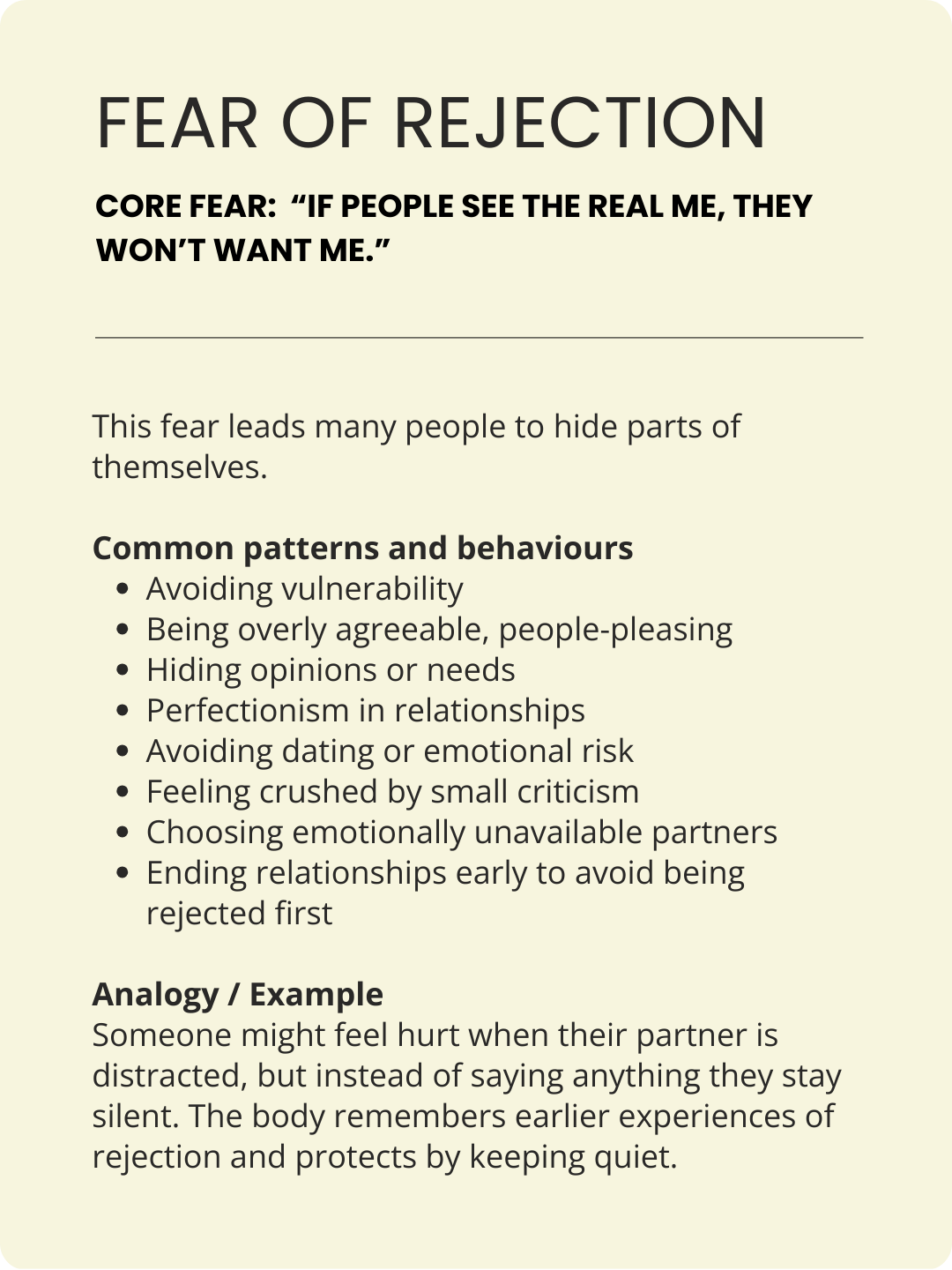
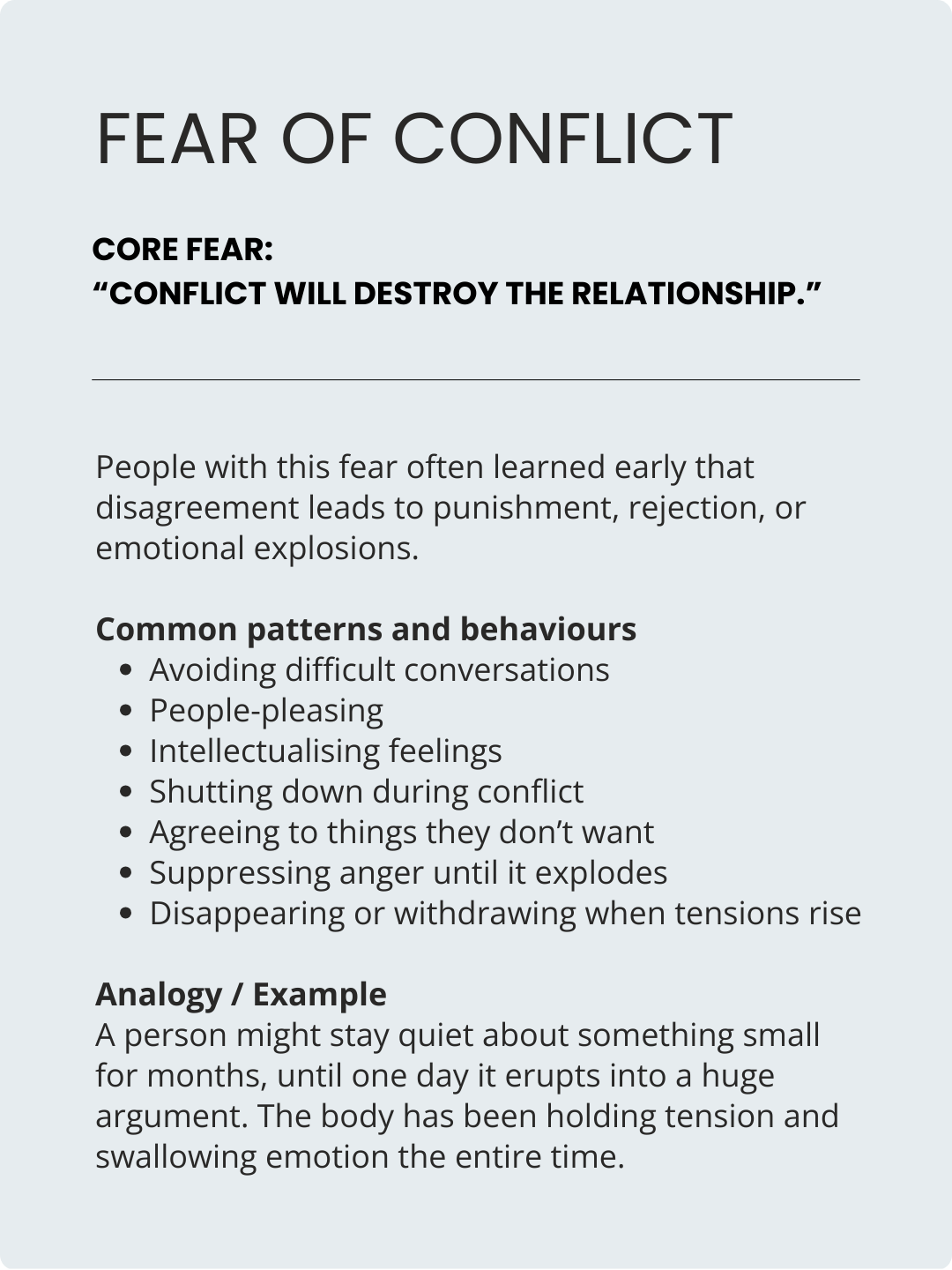
12 Core Relationship Fears
(and how they might shape our behaviour)
Click on the image to read about each of the examples (note: there are many more!).
Most people see themselves in 2-3 of these patterns and , some fears trigger the same behaviours so they might look the same on the outside.
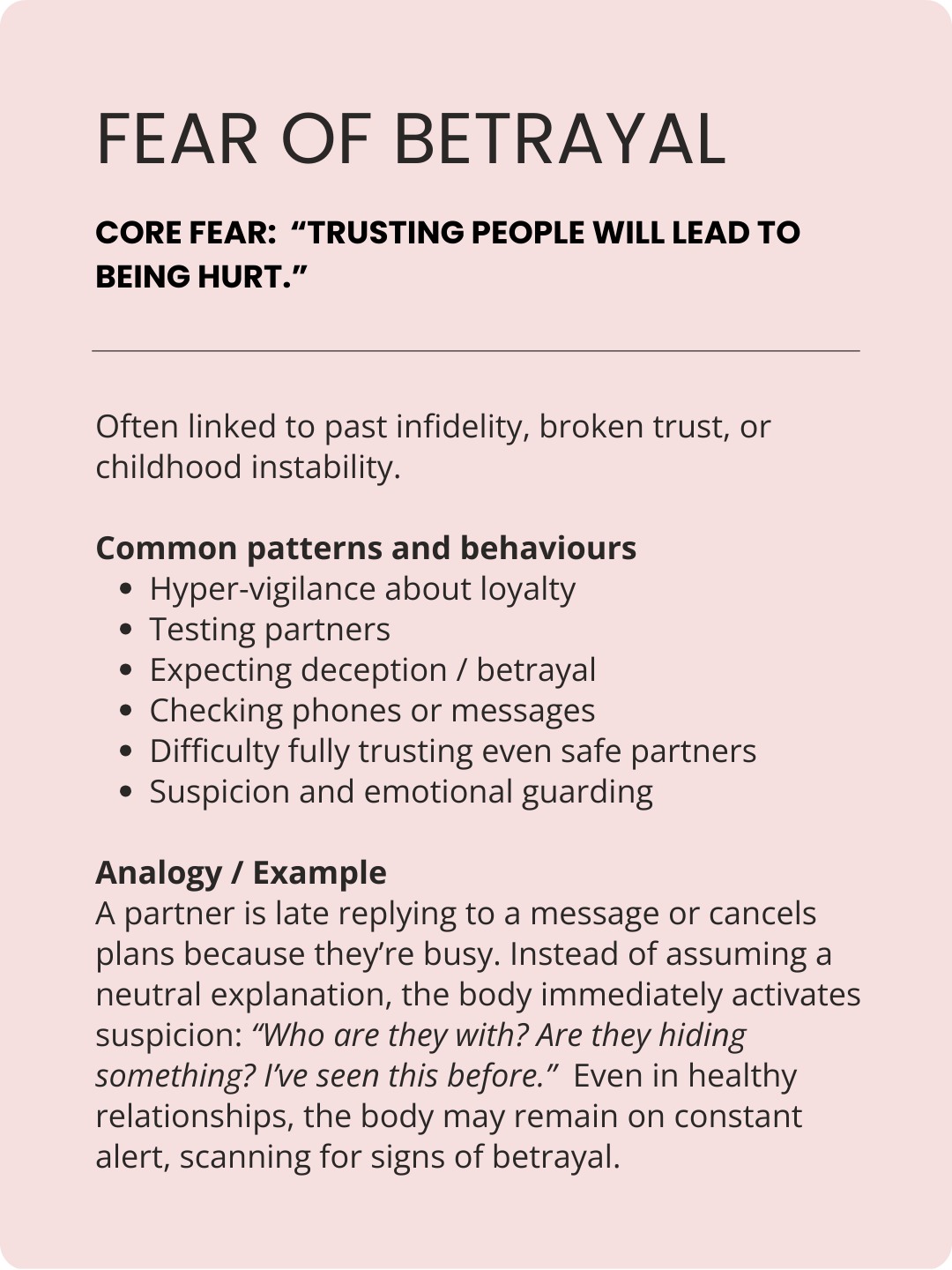
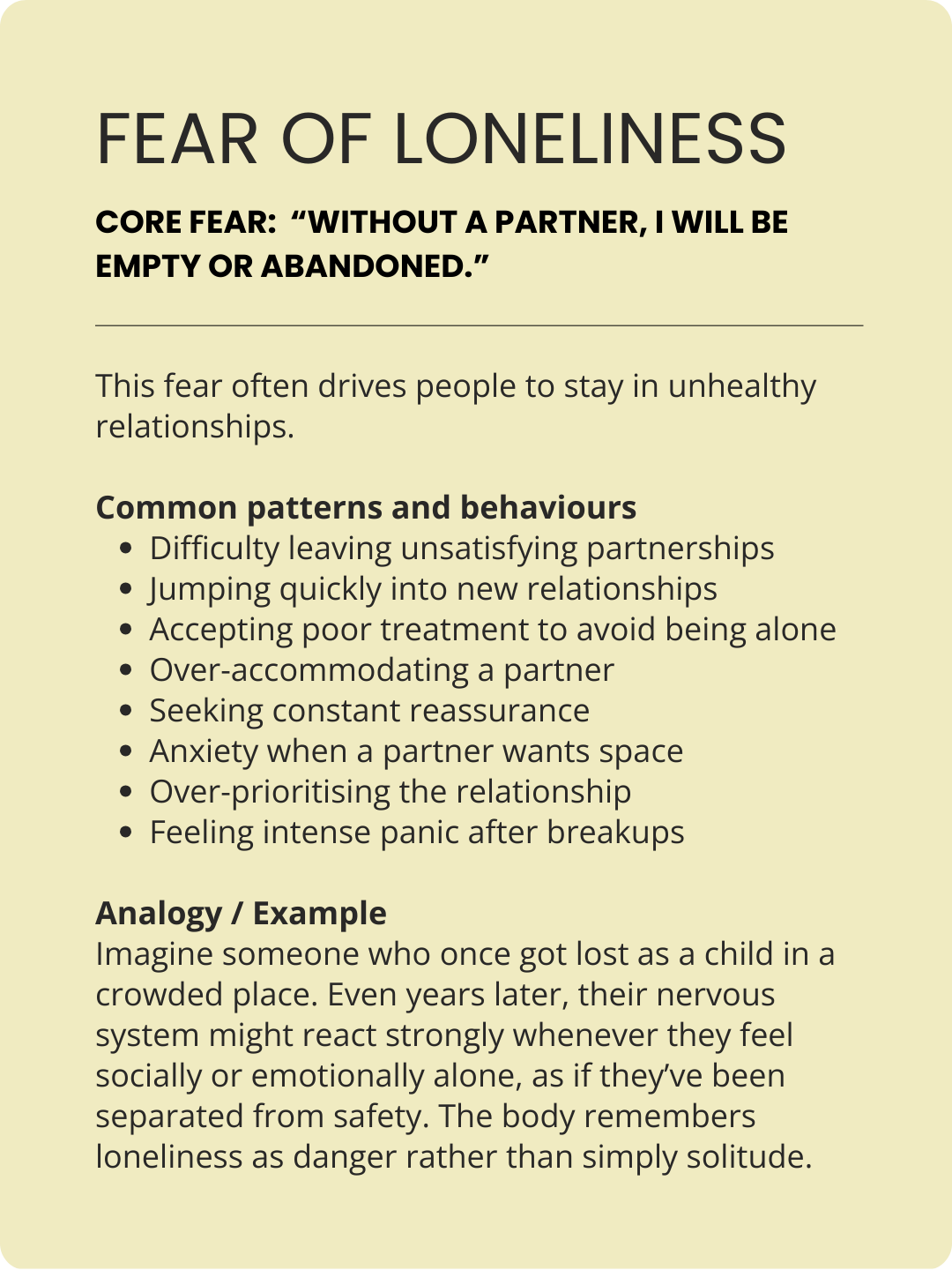
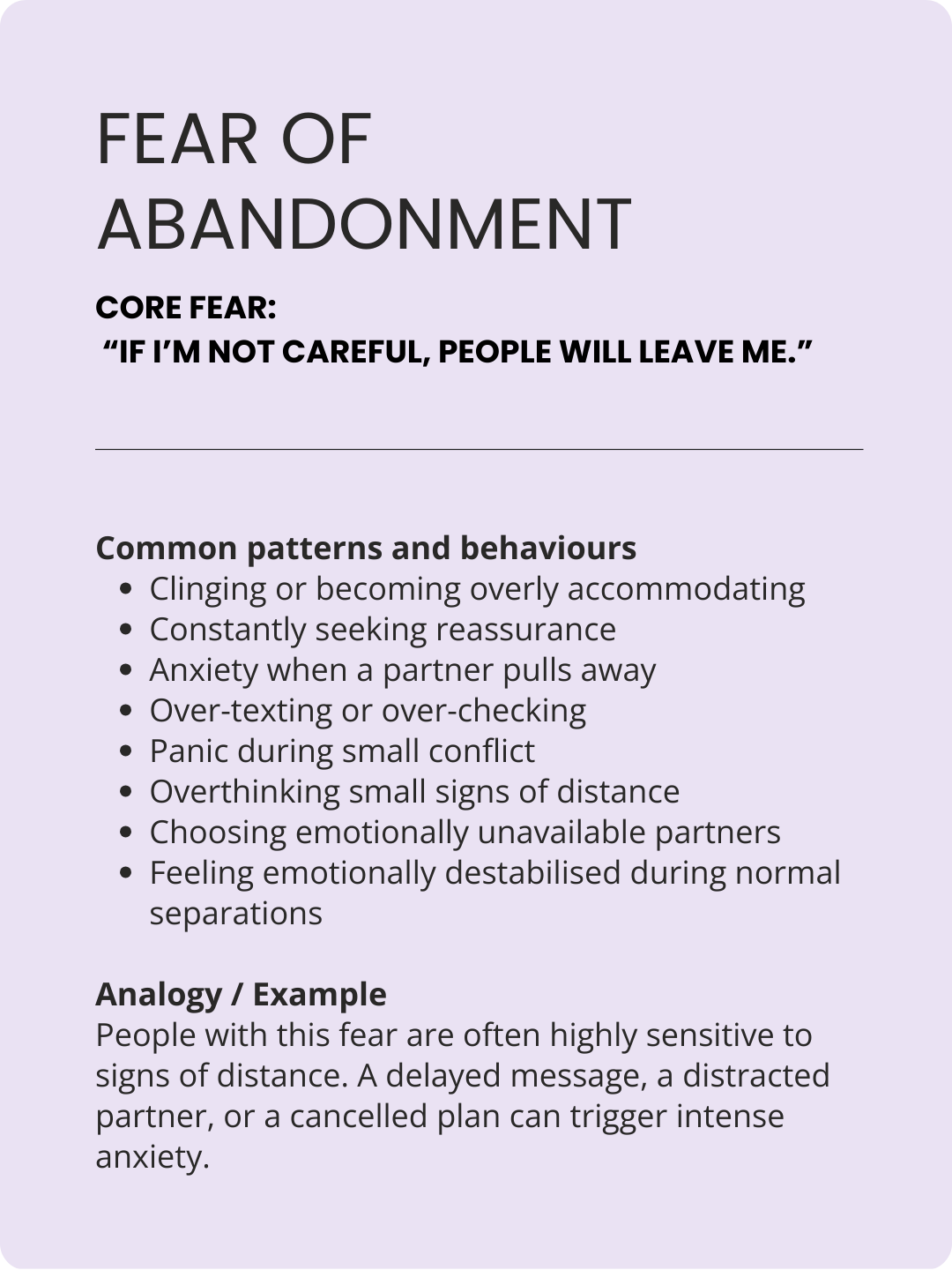
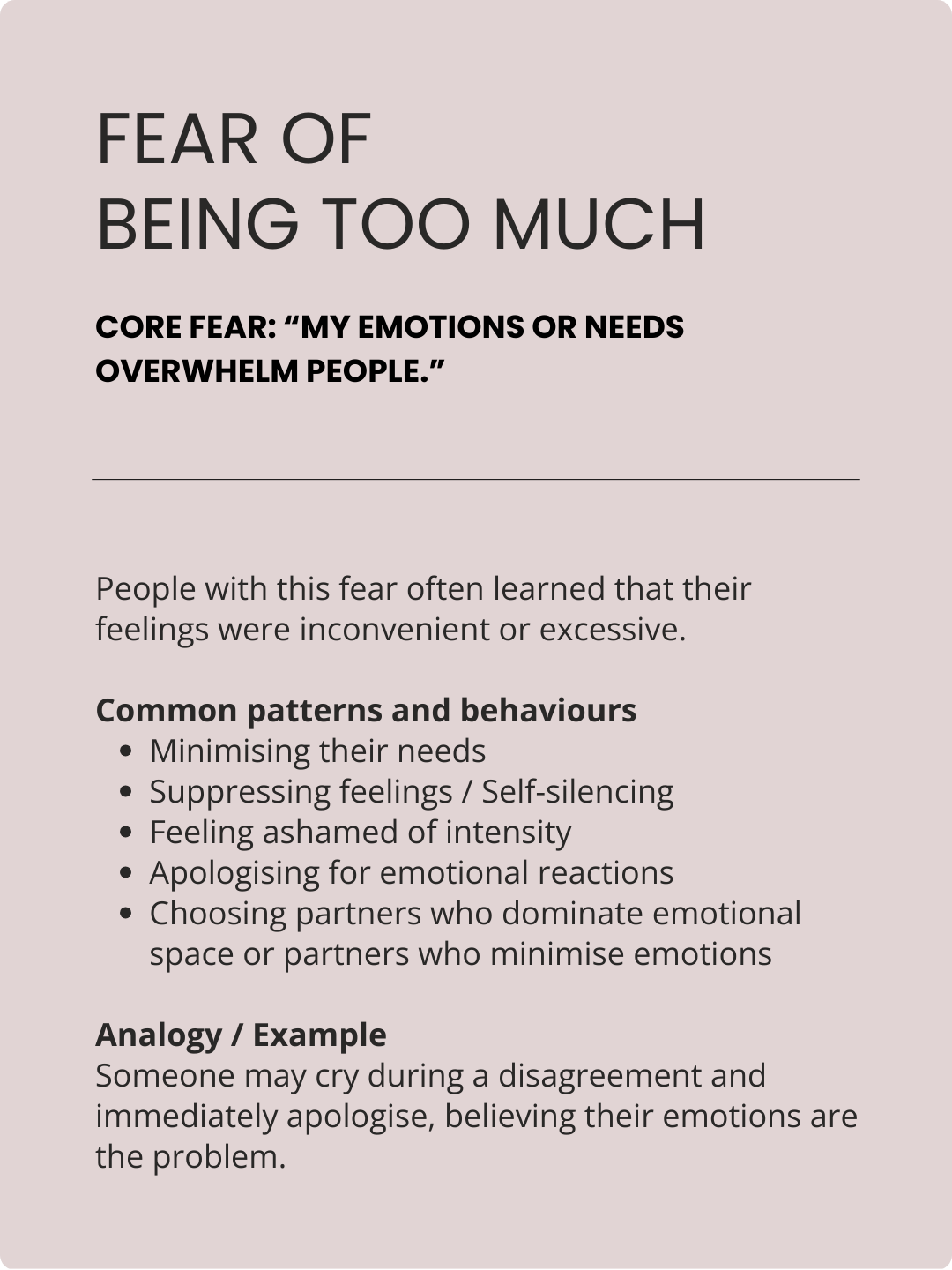
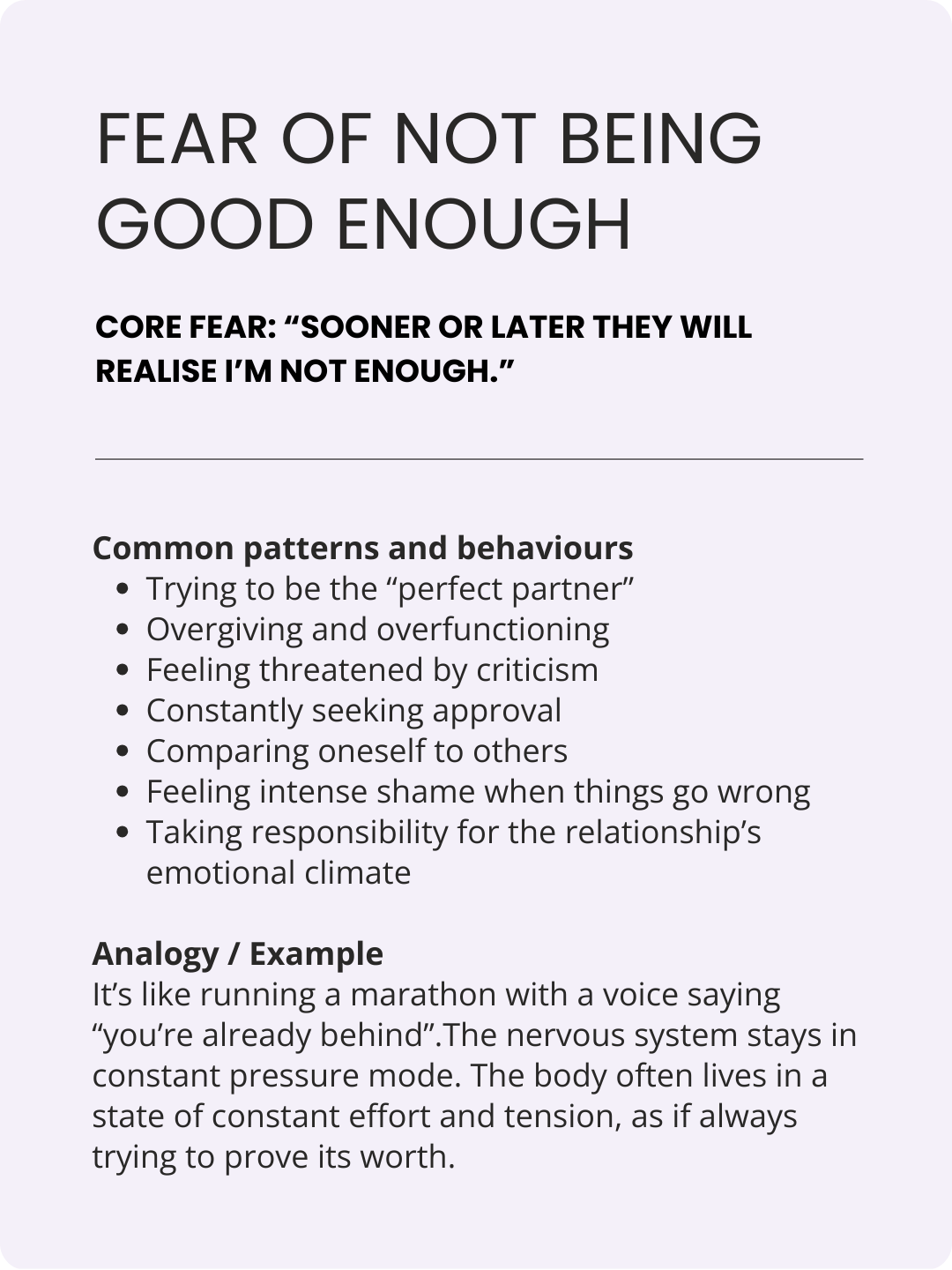
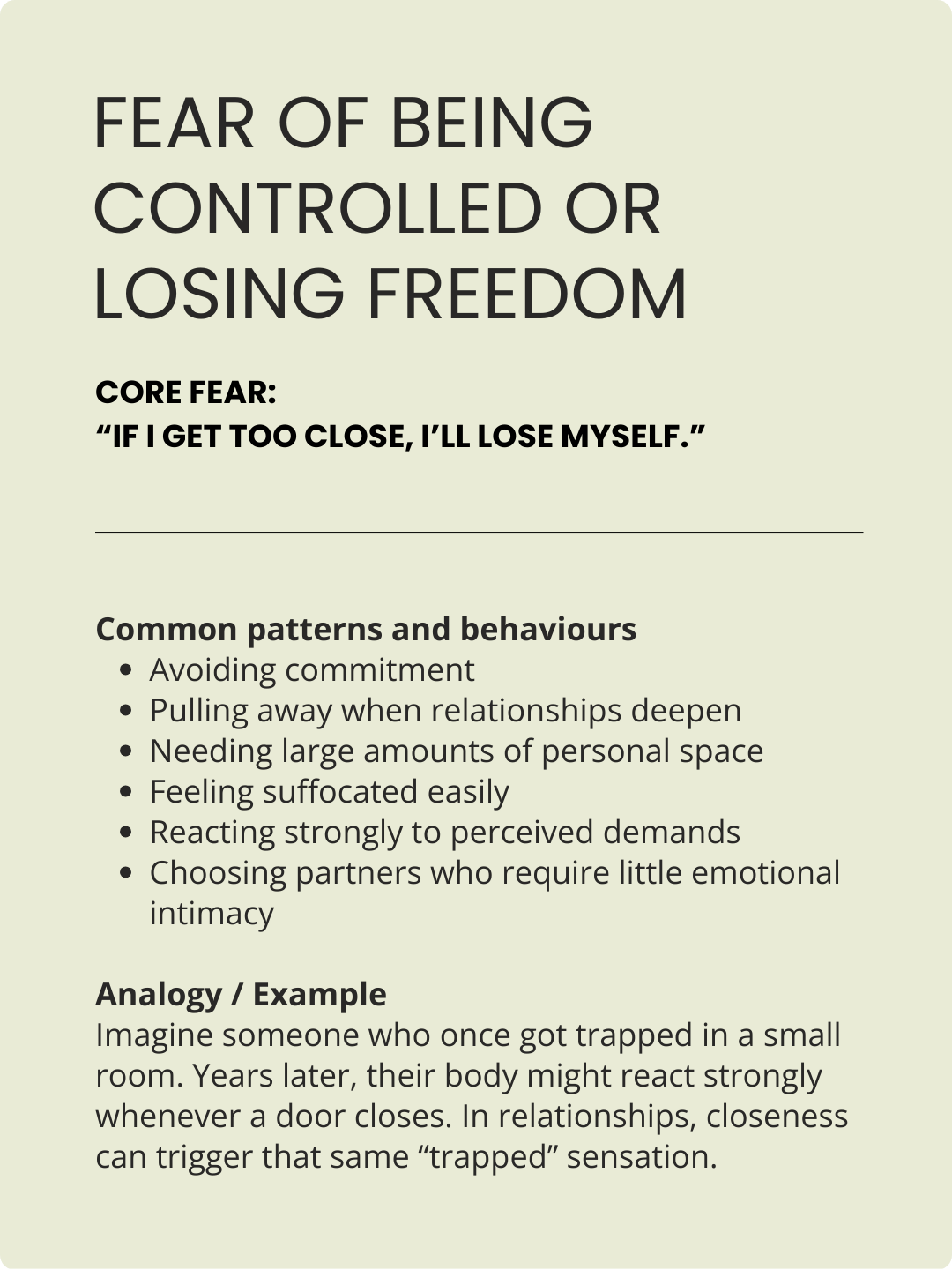
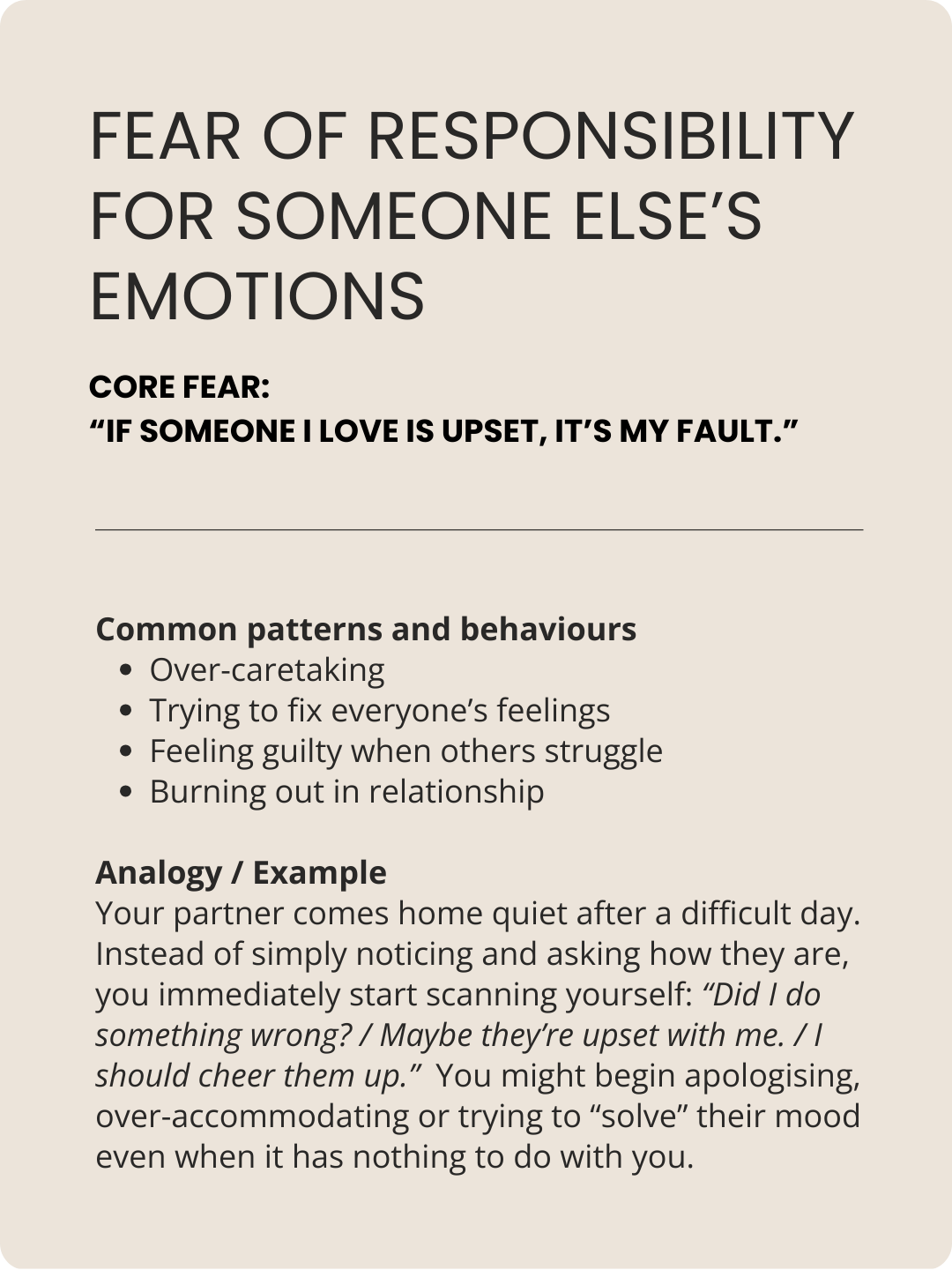
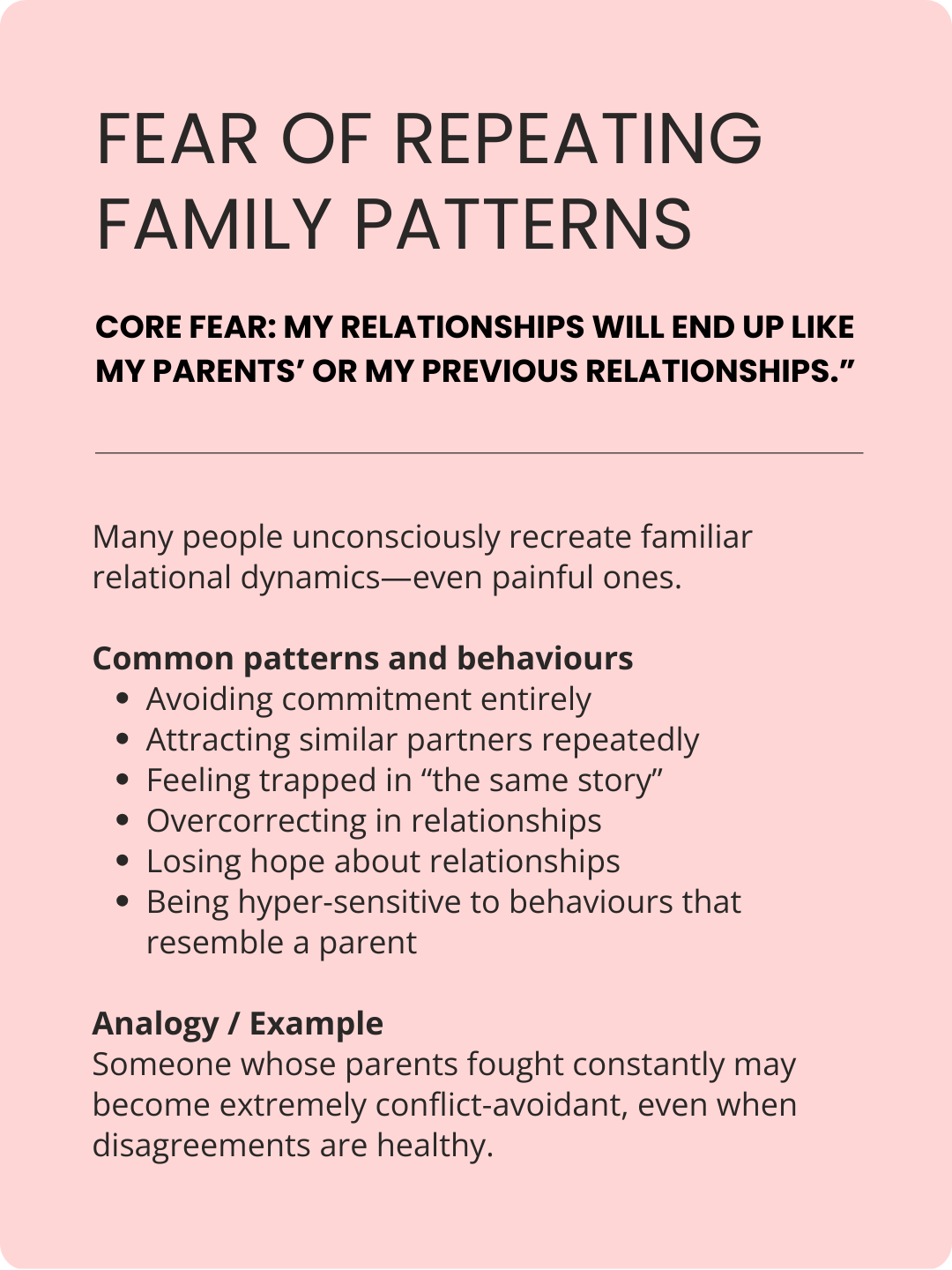
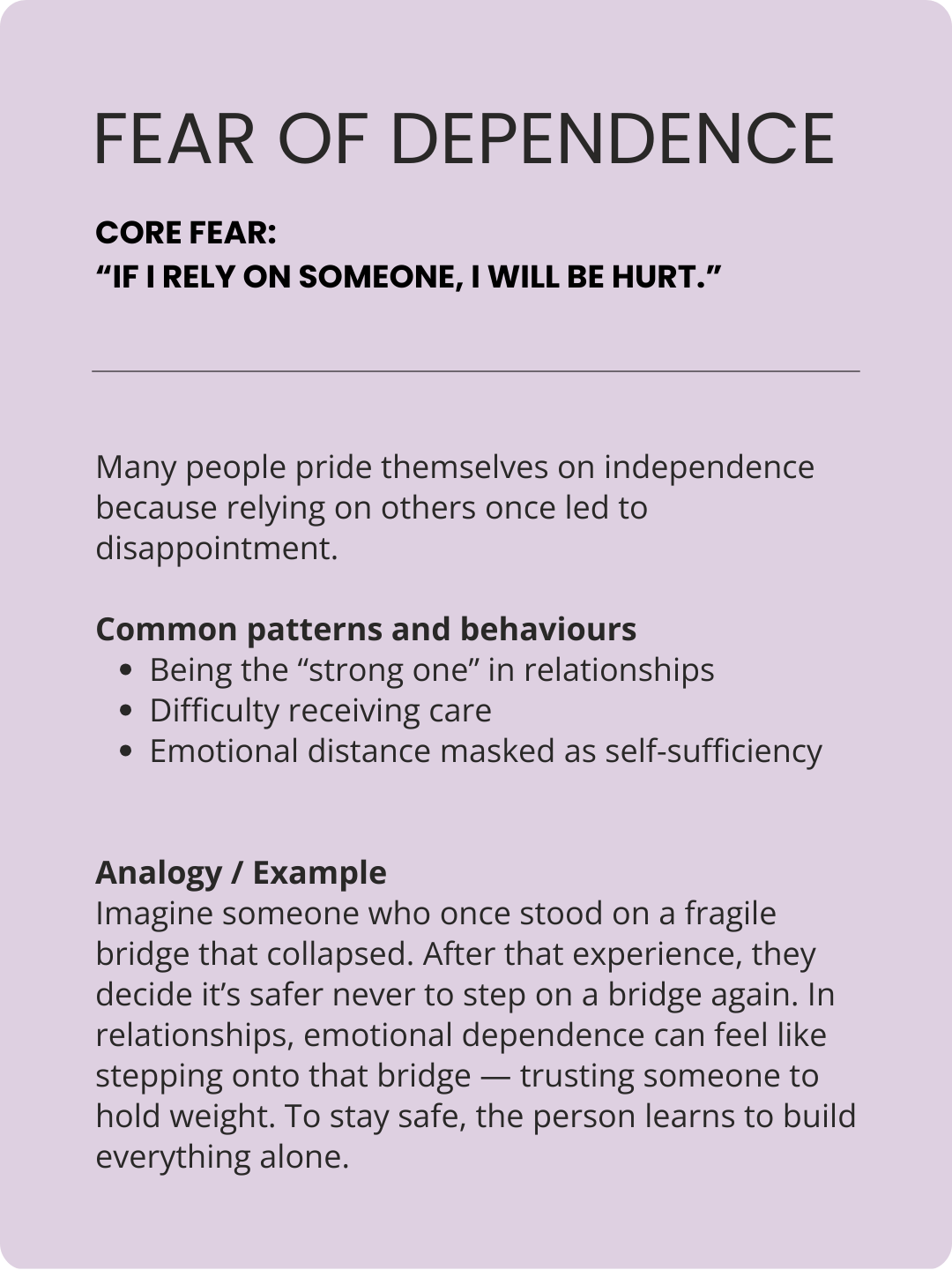
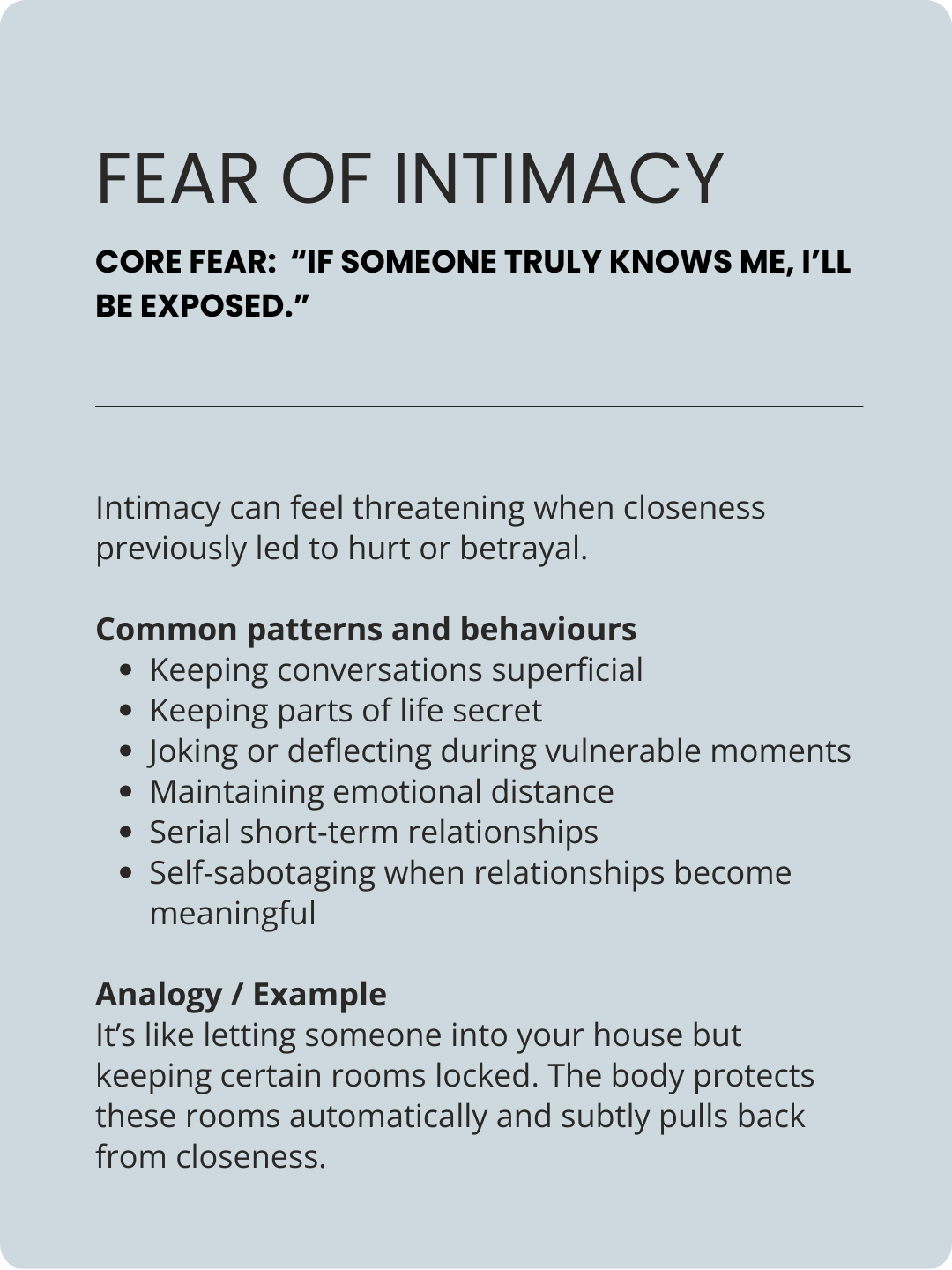
Many people already understand their patterns intellectually.
They might say things like:
“I know I’m overreacting.”
“I know my partner isn’t abandoning me.”
“I know this reminds me of my past.”
But the reaction still happens. Why?
Because these fears are not only psychological, they are physiological patterns in the body.
It’s like trying to stop a reflex by thinking about it. The body reacts before the mind can intervene.
Think of it like this:
Understanding a pattern with words is like reading the instruction manual of a car.
Somatic work is like actually getting under the hood and adjusting the engine.
Why Insight Alone Often Doesn't Break Relationship Patterns
When you work with a somatic modality like The Grinberg Method, you learn how your body is responding and reacting and you can learn to drop the patterns.
As these body patterns change, people often notice that their relationship behaviours change naturally.
They pause instead of reacting.
They speak honestly instead of withdrawing.
They stay present instead of shutting down.
Over time, this creates something powerful:
Choice.
Instead of reacting automatically, people begin to notice:
a pause before responding
the ability to stay present in difficult conversations
less urgency to defend, fix, or withdraw
And as the body changes its response, relationship patterns begin to change naturally.
How Somatic Work Changes Relationship Patterns

It’s important to note:
How you internalise (your body’s reaction) to your relationship fears is unique to you.
You and your siblings may have grown up in the same environment but your coping strategies and behaviour patterns might be very different. That’s where somatic therapies like the Grinberg Method come in…

How the Grinberg Method can help with relationship patterns
-
Distinguish core fear patterns
In the session we will work directly with your body’s automatic reactions when you talk about your partner and your relationships.
Sometimes the body illuminates past memories / stories and experiences that created or reinforced old fear patterns. If this shows up we will tend to this through the body.
Sometimes the body shows us chronic holding patterns in the body that keep you distant and locked in a pattern or story.
-
Interrupt habitual reactions
Depending on your history and coping style, the way you hold automatic fear is individual.
Together we will unravel:
How your body responds to fear
Notice how fear shows up physically
What triggers automatic responses
Recognise automatic tension patterns
Interrupt habitual reactions
The aim is to learn how your body is responding and reacting and you can drop the patterns.
-
Train the nervous system
We are not trying to eliminate relationship fears but instead:
• Recognise fear can be a a signal that needs to be tended to.
• Learn to stay present with the discomfort underneath fear.
• Learn how to increase the nervous system’s capacity for emotional intensity.
• Learn to build bodily capacity in the face of conflict, boundaries, and self-choice.

WHAT NEXT?
Try it out:
Book an intake Session
Please call me on +49 16093174337 if you can’t find a suitable time.
-
Intake Sessions: 90 mins
In the first session, we will get to know each other. The first session also includes an initial diagnosis and a standard treatment, just like any regular session.
Goal: In the first session, you can find out, without obligation, whether the Grinberg Method is right for you.
Follow up sessions: 60 mins
We will begin by discussing any special circumstances and changes since the last session. This will be followed by the regular body-oriented psychotherapy portion. At the end, you will have a few minutes alone to rest.
-
Ostenstraße 11, 85072 Eichstätt, Germany (1 hour from Munich)
Google Maps: htps://maps.app.goo.gl/6X6hgUYJXNzLv6wQ7
-
Sessions are usually conducted with partial clothing / underwear. If you prefer to wear clothes, that’s also ok.
-
In-take Sessions €135 (90 mins)
Follow Up Sessions €110 (60 mins)
-
This totally depends on your insurance. Some private insurances cover all or only part of the treatment while the German public health insurance does not cover any costs
-
Yes.
-
You can reschedule or cancel your appointment free of charge 48 hours prior.
Changes last minute incur 85% no shows incur the full 100% fee.
If you are sick, there is no charge, just send a medical certificate / report via email.